
The novel revision process is where good stories become great ones — and where most indie authors either level up their craft or quietly abandon manuscripts that had real potential. If you've just typed "The End" on a rough draft, congratulations: you've done something most aspiring writers never do. But finishing a draft is only the beginning of the real work.
The gap between a rough draft and a polished novel can feel enormous — and honestly, it is. But it's a gap you can cross systematically, pass by pass, layer by layer. This guide will walk you through the full revision journey, from cooling down after your first draft to the final line-edit polish, with concrete techniques and real examples to anchor every step.
Why the Novel Revision Process Deserves Its Own Strategy
Many writers treat revision as one big blur of "fixing things." They open their manuscript, start reading at page one, and begin tweaking sentences — which is almost always the wrong place to start. Revision is not a single task. It's a series of distinct passes, each with a different focus and different tools.
Think of it the way a film editor works. They don't color-grade footage before they've locked the cut. They don't add sound effects before the pacing is right. They work in layers, from the structural to the granular, because changing the structure after you've polished the sentences is a waste of effort. The same logic applies to novel editing.
The most effective approach to revising a novel manuscript moves through three broad phases:
- Macro revision — structure, plot, character arcs, pacing
- Micro revision — scene-level craft, dialogue, tension, point of view
- Line editing and proofreading — sentence clarity, word choice, grammar
Skipping ahead to line editing when your structure is still broken is like painting a wall before the plaster has dried. Let's start at the foundation.
Step One: Create Distance Before You Begin
Before you touch a word of your manuscript, put it away. This is not optional advice — it is the single most important thing you can do to improve the quality of your revision. Writers who revise immediately after drafting are editing the story they intended to write, not the one they actually wrote.
The standard recommendation is two to four weeks away from the manuscript. Some authors take longer. Donna Tartt reportedly spends years between drafts. You don't need years, but you do need enough distance that when you read the opening chapter, you're slightly surprised by what's there.
Use this time productively. Read widely in your genre. If you have other projects, work on them. Consider drafting any scenes or chapters you know are missing, if they're fresh in your mind — but save them in a separate document and don't integrate them yet. If you want to keep your writing momentum going during this cooling period, writing sprints: how to boost your daily word count on other projects can keep your skills sharp without contaminating your manuscript's freshness.
The Read-Through Pass
When you return to the manuscript, do a full read-through before changing anything. Read it the way a reader would — ideally in as few sittings as possible, even if that means a long weekend. As you read, take notes in a separate document. Do not stop to fix things. Do not rewrite that clunky sentence in chapter three. Note it and keep moving.
What are you looking for in this pass? Everything that makes you feel something — boredom, confusion, surprise, delight, or dread. Those emotional responses are data. Boredom usually signals pacing problems or scenes that aren't earning their place. Confusion often points to unclear motivation or a logic gap in the plot. Make a note of the chapter number and the feeling, and keep going.

Macro Revision: Fixing Structure and Character Arcs
Now the real work begins. Armed with your read-through notes, you're going to address the biggest issues first: the structural problems that affect the entire novel.
Evaluating Your Story Structure
Whether you work with three-act structure, the Save the Cat beat sheet, story circles, or your own intuitive framework, the core question is the same: does your story's shape make sense? Does the midpoint actually shift the story's direction? Does the darkest moment before the climax carry genuine weight? Is there a clear transformation — in character, situation, or both — from the first page to the last?
One useful tool is a scene-by-scene outline created after the first draft — sometimes called a reverse outline. Go through your manuscript and write one sentence for each scene: what happens, and what changes as a result. If you can't identify what changes in a scene, that scene is a candidate for cutting or combining. This is also the moment to spot structural gaps: chapters that stall the story, subplots that vanish without resolution, or a climax that arrives before enough tension has been built.
Deepening Character Arcs During the Revision Process
Character arc problems are among the most common issues in first drafts, and they're often harder to spot than plot holes because they're invisible. Your protagonist may do all the right things at all the right moments — but if those actions don't feel earned by a genuine internal shift, readers will close the book feeling vaguely unsatisfied without quite knowing why.
Ask yourself: what does your protagonist want (external goal), what do they need (internal truth they're resisting), and what is the lie they believe about themselves or the world at the story's opening? The arc of a compelling character is the journey from the lie to the truth — or, in tragedy, the failure to make that journey.
In your first draft, those elements might be present but underdeveloped. A macro revision pass is the time to seed earlier scenes with hints of the internal wound, deepen the moments of resistance, and make the character's eventual change feel inevitable in retrospect.
Before (flat character motivation):
Sarah decided to go back to the town she'd left years ago. It wasn't something she'd planned, but when the call came about her father's house, there didn't seem to be much of a choice. She packed a bag and drove north.After (arc-informed revision):
The call about her father's house lasted four minutes. Sarah spent the next three days convincing herself she didn't have to go — that there were lawyers for this, estate agents, sensible intermediaries who wouldn't have to stand in his kitchen and remember. But she packed a bag on Thursday morning before the logical part of her brain had fully woken up, and by noon she was on the motorway heading north, already rehearsing the version of herself she'd need to be when she got there.
Notice that the revised version doesn't just tell us Sarah is reluctant — it shows a character actively negotiating with her own resistance. That's arc work happening at the sentence level, informed by macro understanding of who this character is.
When revising character arcs, create a simple one-page "character bible" for each major character: their lie, wound, want, need, and the moment in your story when each of those is most directly challenged. Keep it open while you revise. It prevents drift and helps you spot scenes where the character behaves inconsistently with their established psychology.
Micro Revision: Strengthening Scenes and Prose
Once you're satisfied with the structural shape of your novel — the arcs make sense, the pacing works, no major scenes need to be invented or killed — you move into scene-level revision. This is where the craft work becomes more granular and, for many writers, more enjoyable.
Tension and Scene Goals
Every scene needs a goal, conflict, and outcome — a principle popularized by writing teacher Dwight Swain and expanded by James Scott Bell and others. The goal is what the point-of-view character wants in this scene. The conflict is what stands in the way. The outcome is either a yes (goal achieved), a no (goal blocked), or a yes-but or no-and (the most interesting outcomes, because they complicate rather than resolve).
Go through your reverse outline again. For each scene, can you identify the goal, conflict, and outcome? Scenes that can't pass this test are often the ones that feel slow or purposeless to readers.
Dialogue That Does Double Duty
First-draft dialogue often does one thing at a time: it conveys information, or it reveals character, or it advances plot. Polished dialogue does several things simultaneously. It conveys information through character voice, which also reveals relationship dynamics, which also creates or releases tension, which also advances the plot.
Elmore Leonard's advice to skip the parts readers skip applies here. In revision, read every dialogue scene aloud. If you're skimming your own words, your readers definitely will be.
Point of View Consistency
POV drift is one of the most common and most damaging issues in self-edited manuscripts. Head-hopping — shifting without intention between characters' thoughts within a single scene — breaks reader immersion more effectively than almost anything else. During your micro revision pass, flag every instance where you access a character's internal thoughts and make sure they belong to the established POV character for that scene or chapter.
This doesn't mean limited third person is the only valid choice. Omniscient narration can head-hop deliberately and beautifully — Tolstoy did it, as did George Eliot. But omniscient narration requires consistency of narratorial voice to work. If your omniscient narrator has no distinct personality, the head-hopping reads as error rather than technique.
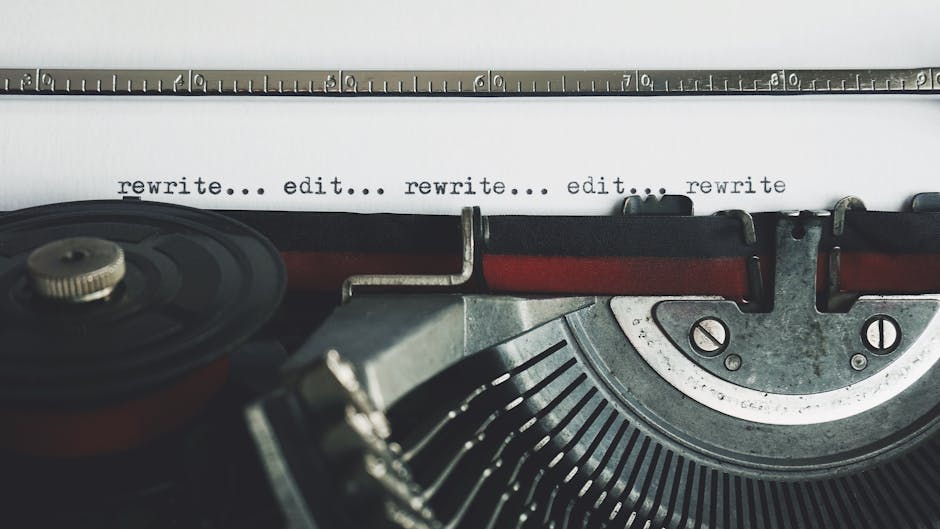
Cutting the Manuscript: The Art of Subtraction
No revision guide is complete without an honest conversation about cutting. Most first drafts are longer than they need to be — not because the writer is undisciplined, but because discovery writing generates material that was necessary to find the story, not material that belongs in the final version.
The rule of thumb often cited in workshops is that a tight, publishable novel should be approximately 10–20% shorter than the first draft. That number feels alarming until you start cutting and realize that much of what you're removing is scaffolding: setup scenes that got replaced by better setup, backstory that you now weave in elsewhere, dialogue that repeated information the reader already had.
There's an entire craft to this kind of surgical reduction. If you want a detailed framework for approaching it, how to cut 20% of your manuscript without losing the story is a practical guide that walks through the process chapter by chapter. The core principle: cut what doesn't serve the story, and trust the story to be stronger for it.
Before cutting anything you love, paste it into a "cuts archive" document. This removes the psychological barrier of permanent deletion. In practice, you will almost never return to that document — but knowing it exists makes it dramatically easier to cut.
Line Editing: Polishing Every Sentence
You've fixed the structure. You've strengthened the scenes. Now — and only now — is it time to work at the sentence level. Line editing is the process of improving the clarity, rhythm, precision, and musicality of individual sentences and paragraphs.
Common Line-Editing Targets
In a typical first draft, you'll encounter several recurring patterns worth addressing:
- Passive constructions used where active verbs would create more energy
- Throat-clearing phrases — "She began to feel," "He started to walk," "It seemed like" — that distance readers from direct experience
- Over-reliance on adverbs attached to dialogue tags when a better verb or action beat would do the work
- Repeated words or sentence structures in close proximity
- Abstract language where concrete, specific detail would be more vivid
Before (distance-heavy prose):
It seemed to Marcus that the room was beginning to feel smaller. He started to become aware of the way the walls appeared to press inward slightly, and he felt a kind of growing dread that he couldn't quite explain.After (grounded, specific prose):
The room had shrunk. Marcus couldn't explain it — the dimensions hadn't changed, the same four walls stood where they always had — but the air had thickened, and each breath came a little shorter than the last. Something was wrong in here. Something that hadn't been wrong an hour ago.
The revised version eliminates every layer of distance ("it seemed," "he started to become aware," "he felt") and replaces abstract dread with physical sensation and specific detail. The unease is now happening to the reader, not being reported to them.
For a thorough approach to this phase, including specific exercises for improving sentence rhythm and precision, line editing tips: how to polish every sentence goes deep into the techniques that separate competent prose from genuinely compelling prose.
Reading Aloud as a Revision Tool
There is no substitute for reading your manuscript aloud during the line editing pass. The ear catches what the eye skips: repeated words, awkward rhythms, sentences that technically make sense but don't flow. If you stumble over a phrase while reading aloud, your reader will stumble silently — and they may stop reading altogether.
Some writers use text-to-speech tools during this stage, which forces an even more mechanical, impartial read. Tools like AI editing tools for novels can also assist with flagging patterns across a long manuscript — repetitive word choices, passive constructions, and tonal inconsistencies that would take hours to find manually. ProseEngine, for instance, is designed specifically for fiction writers and can surface these patterns in context, which means you're not just catching errors — you're understanding why certain sentences underperform.
Using Beta Readers and Professional Editing
At some point in the revision cycle — typically after your macro and micro passes, but before or during line editing — external readers become invaluable. The core problem with self-editing is that you know what you meant to write. A reader only knows what's on the page.
Beta readers are ideal after structural revision is complete. Give them a clean copy and ask specific questions: Where did you slow down? Were there any characters whose motivations confused you? Did the ending feel earned? Avoid asking "Did you like it?" — that question generates feelings, not actionable craft feedback.
If budget allows, a developmental editor addresses structure and character; a copy editor addresses consistency and grammar; a proofreader catches final errors. These are distinct skill sets, and many indie authors make the mistake of hiring one person to do all three. If you're comparing AI-assisted editing options before committing to a human editor, a breakdown like ProseEngine vs Sudowrite for editing can help clarify which tools are better suited to different stages of the revision process.
How Many Revision Passes Does a Novel Need?
The honest answer: as many as it takes, and fewer than you fear. Most authors who have a solid revision process — working through macro before micro before line — find that three to five full passes gets a manuscript to publishable quality. The trap to avoid is infinite tinkering: the manuscript that never leaves the revision stage because the author is using revision as a substitute for the terror of being done.
Set a criterion for completion before you start your final pass. "I will finish when every chapter has been through a line edit and the manuscript has been proofread once" is a measurable endpoint. "I will finish when it feels perfect" is not — because it never will, and that's not a failure of the manuscript; it's a feature of the creative process.
Nabokov famously said that all writing is rewriting. But even Nabokov published his books.
Build a reverse outline for one chapter to spot scenes that change nothing
- Open your draft to any chapter and read through it with a pen in hand, drawing a horizontal line between each distinct scene or beat where the location, time, or situation shifts.
- Write one sentence beside each section you've marked, following this exact pattern: "[Character] does [action], and as a result [what changes]" — if you cannot honestly complete the "as a result" half, circle that section.
- Count how many sections you circled and list them by page number; each circled entry is a candidate for cutting, collapsing into a neighbouring scene, or rewriting so that something — a relationship, a belief, a situation — is measurably different by the scene's end than it was at the start.
Running this reverse-outline check across a full novel-length manuscript typically takes eight to twelve hours of focused reading and notation.
Key Takeaways
- Revise in layers: always address structural problems before scene-level issues, and scene-level issues before line editing — working out of order wastes effort.
- Create distance before you begin. At minimum two weeks away from the manuscript allows you to read what's actually on the page, not what you intended to write.
- Use a reverse outline after your first draft to identify scenes that don't change anything — these are your primary cutting and strengthening targets.
- Cut aggressively and without guilt. Most first drafts are 10–20% longer than they need to be, and tighter prose is almost always stronger prose.
- Read every scene aloud during line editing, and bring in beta readers after structural revision is complete — external perspective reveals blind spots no amount of self-editing can fix.
The Revision Mindset: Patience as a Craft Skill
The writers who consistently produce polished, compelling novels are not necessarily more talented than writers who struggle with revision. They have, in most cases, made peace with the process. They don't experience the gap between their first draft and their vision as a judgment on their abilities — they experience it as the work itself.
Revision is where you discover what your story is actually about. It's where characters reveal depths you didn't consciously plan. It's where a clunky early chapter transforms into a reader's favorite passage. The rough draft got you to the story. The novel revision process is how you give that story to someone else.
Start with structure. Move to scenes. End with sentences. Take your time, be ruthless about what isn't working, and trust that the work you're doing in revision is the most important writing work you'll ever do.